
Preparing for the CMPP™ Exam – Q&A Guide

Updated: Jun 15

Q: What is the CMPP™ exam and why is it important?
The CMPP™ (Certified Medical Publication Professional) exam, conducted by the International Society for Medical Publication Professionals (ISMPP), is a globally recognized credential that validates expertise in medical publications, ethics, and Good Publication Practices (GPP). For medical writers, it enhances credibility, career advancement, and demonstrates commitment to ethical and professional standards in publication planning.
Q: Who is the certification body?
The exam is administered by ISMPP, the leading global organization dedicated to medical publication professionals. ISMPP sets the standards, provides resources, and ensures the exam reflects current best practices in the field.
Q: What are the fees for the exam?
As mentioned on the CMPP official website, the exam fee is $595, except in developing countries, where it is $395. The retake fee is $250 for those candidates who do not pass the exam and retake it during the next testing window.
Non-ISMPP members are required to pay the $235 non-member administrative fee ($195 for those in developing countries), which includes a complimentary year of ISMPP membership. This fee covers the cost of setting up their profile in LearningBuilder to access the exam application.
Refer to the website link below for more details on the exam overview, application process, exam fees, test centre scheduling, eligibility criteria, and exam results.
Q: When and how is the exam conducted?
The exam is offered twice yearly (June and September) in 30‑day testing windows. Next exam is scheduled in September (September 1 to 30, 2026). Application deadline is August 1, 2026.
Q: What is the structure of the exam?
The CMPP™ exam is a 3‑hour multiple‑choice test covering publication planning, ethics/compliance, and professional practice. It assesses both knowledge and application. Understanding the blueprint and practicing case scenarios are key to success.
The three knowledge domains tested are:
Developing a publication plan
Implementing a publication plan
Fostering ethical and compliant behavior in publications
Psychometric validation is an integral part of the exam development process, ensuring that candidates are assessed across all dimensions of professional publication planning. The exam consists of 150 computer‑based, multiple‑choice questions, each psychometrically validated for reliability and fairness. Results are reported on a pass/fail basis.
Q: What strategies help in preparing for the exam?
Plan early: Begin preparation 3–4 months before the exam window.
Structured study: Dedicate weekly blocks to ethics, guidelines, and emerging practices.
Leverage ISMPP membership: Access webinars, archives, and peer forums for insights.
Practice under timed conditions: Simulate the 3‑hour exam to build stamina.
Focus on judgment: Many questions test ethical decision‑making rather than rote recall.
Quick‑recall sheets: Summarize guidelines and ethical principles for last‑minute review.
Q: What are the best practices to ace the exam?
Balance theory with practical examples from your own publication projects, strengthen manuscript evaluation skills (especially case reports and original science articles), and build fluency in metrics and reporting standards. Engage with peers, attempt mock exams, and stay updated on emerging trends in medical publications.
Road Map to Success
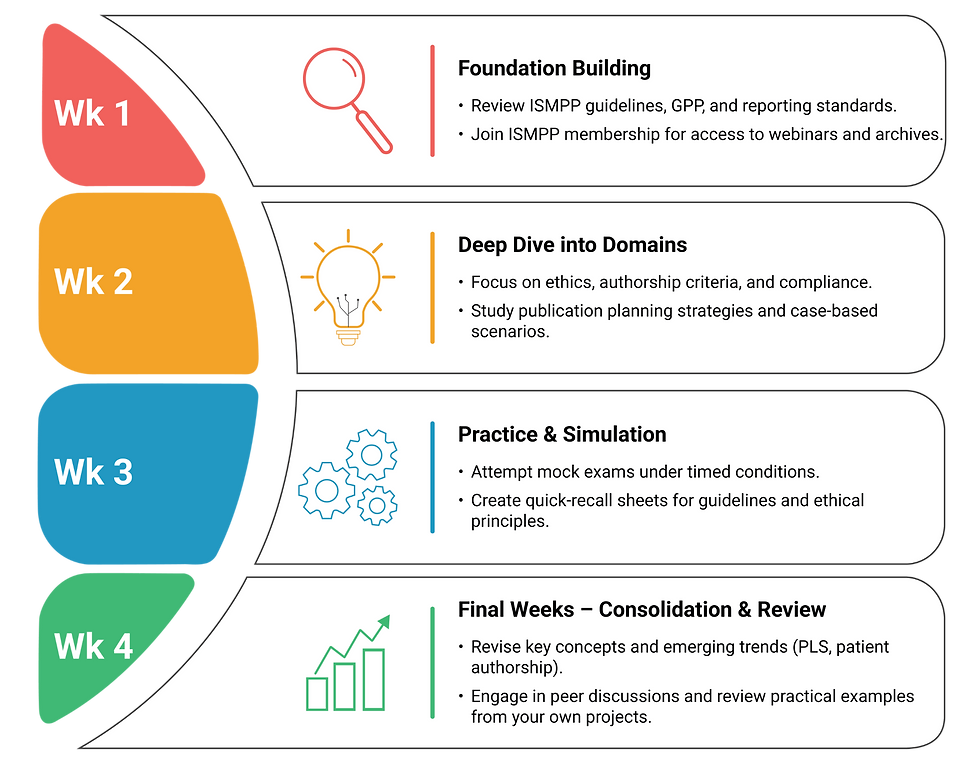
This article builds on the recent webinar led by Ms. Priyanka Grandhi, with valuable insights shared by Ms. Danita Sutton, PhD, ISMPP CMPP™ – Senior Director, Credentialing & Communications at ISMPP. Their discussion highlighted practical steps for exam preparation, ethical decision‑making, and strategies to approach case‑based questions with confidence.
Disclaimer
The information provided on this website is intended solely for educational purposes. While every effort has been made to compile and verify the content with care, the authors, the MedWriters team, their partners, agents, and sponsors accept no responsibility or liability for any errors, omissions, or inaccuracies, whether arising from negligence or otherwise, nor for any consequences resulting from the use of this information. Readers are advised to independently verify details or contact the relevant service provider before applying for any role. For complaints or feedback, please write to support@medwriters.in


Comments